AI Search for Yoga Studios in Paris (2026):Same question, a different answer on every engine
TL;DR: I took the playbook from our AI hotel studies and pointed it at something closer to my heart — where the robots send you for yoga in Paris. 27 prompts, 5 AI engines, English and French, matched against 369 real studios. The verdict? There’s no such thing as “AI search.” Ask the same question five times and you get five different answers — Yay, The Space and Ashtanga Yoga Paris top the table overall, but who you actually see depends entirely on which AI you ask and what language you ask it in. The kicker is personal: my own studio, Modo Yoga Paris, lands #4 overall — yet Gemini and Google AI Mode act like it doesn’t exist. Same studio, same city, wildly different machines.
Executive Summary
First time we’ve pointed the AI-search methodology at something other than hotels — and yoga turned out to be the perfect crash test for what’s a universal law of AI search and what was just a hotel quirk.
The setup is deliberately identical to our hotel studies: one fixed set of prompts, fired at several AI engines, in two languages, from two countries, all in a single week — except this time the question was where to do your downward dog in Paris, not where to sleep. Across 27 prompt templates and 5 engines we grabbed every answer, pulled out the studios each one named with a named-entity-recognition pass, and matched them to 369 real Paris studios.
The headline survives the switch intact: the engines can’t agree on where to look. Copilot is basically a phone book — 96% of what it cites is studios’ own websites. Perplexity and Gemini lean the same way (52% / 41%). ChatGPT learns about Paris yoga the way a newcomer would — off Reddit threads and magazine listicles, with Reddit its single most-cited source. And Google AI Mode mostly cites… Google, linking back to its own search results half the time. The kicker is personal: the studio I actually practise at, Modo Yoga Paris, ranks #4 across the board — and yet Gemini and AI Mode behave as if it doesn’t exist. Win one engine, vanish on another.
I practise yoga all over Paris — a different studio depending on the week, the style and the mood. One of my favourites, and the place where I did my 500-hour teacher training, is Gérard Arnaud Yoga.
So when I started poking at how AI engines recommend yoga studios in Paris, the first thing I did was the obvious, selfish thing: I checked whether they’d send someone to the studios I actually love. Most of them, they would. But Gérard Arnaud kept vanishing from my rankings — even though I could see the engines naming it in their answers. The leaderboard said invisible; the answers said otherwise.
That contradiction is what made me run the whole hotel-research playbook on yoga: 27 prompts, five engines, two languages, one week. The rest of this piece is what I found — and why a studio can be recommended yet read as a zero turns out to be one of the most useful lessons in it.
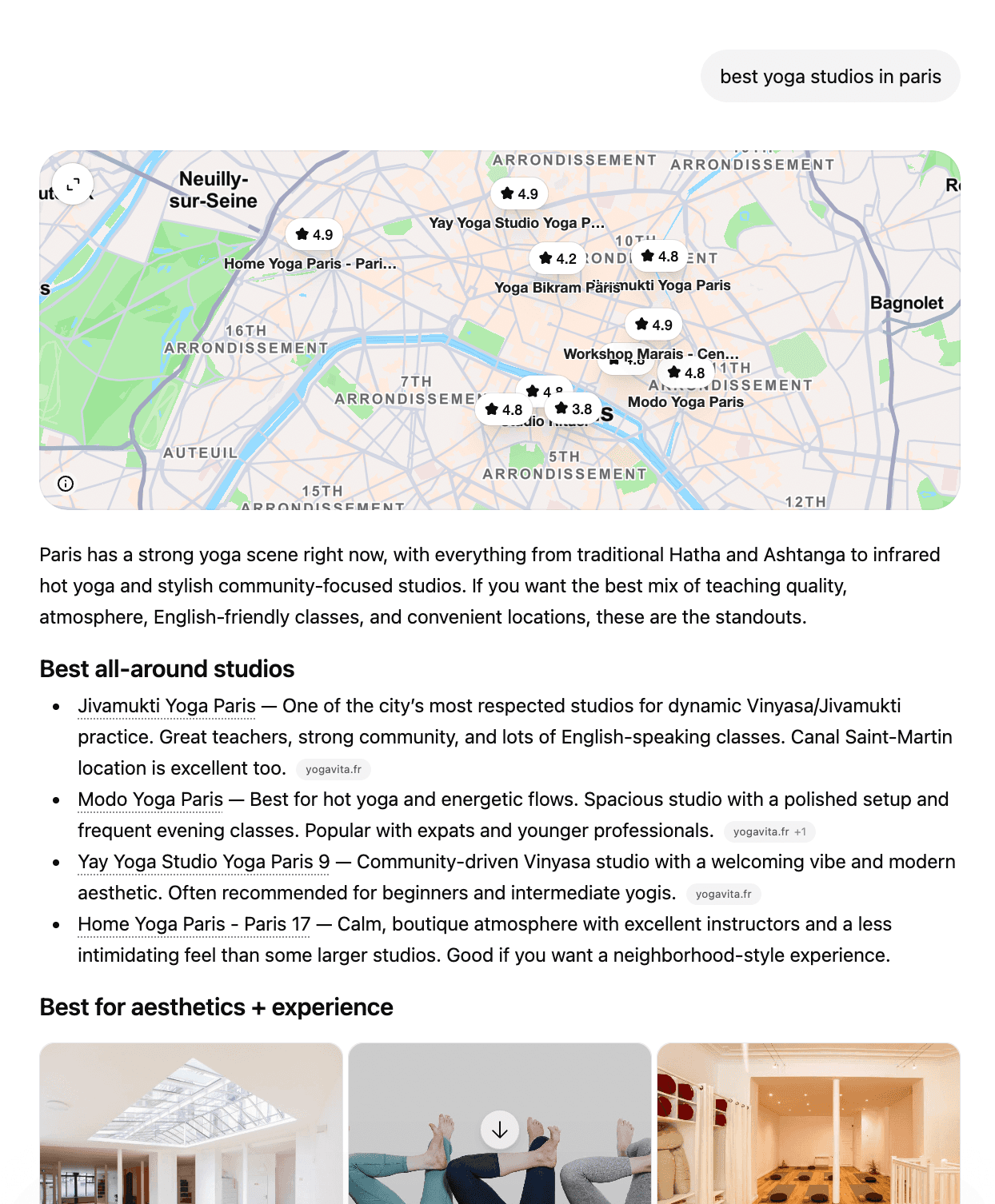
yogarita.fr. Jivamukti, Modo, Yay and Home Yoga all appear here — the same names that top the leaderboard below.The prompts
Everything downstream depends on the prompt set, so here it is in full. We used 27 templates, each written once in English and once in French, then ran every one from both a US and a French proxy on all 5 engines. The templates aren’t random questions — they’re a deliberate matrix designed to probe the dimensions that matter for local discovery: the generic “control” query, specific yoga styles, experience level, persona/use case, price, time, vibe, neighborhood, format, and one deliberate entity-bleed control (pilates) to measure how cleanly the models separate adjacent disciplines.
control | ENbest yoga studios in Paris | FRmeilleurs studios de yoga à Paris |
style_vinyasa | ENbest vinyasa yoga studios in Paris | FRmeilleurs studios de vinyasa à Paris |
style_hot | ENbest hot yoga studios in Paris | FRmeilleurs studios de hot yoga à Paris |
style_ashtanga | ENbest ashtanga yoga studios in Paris | FRmeilleurs studios d'ashtanga à Paris |
style_yin | ENbest yin yoga studios in Paris | FRmeilleurs studios de yin yoga à Paris |
style_mysore | ENmysore ashtanga in Paris | FRmysore ashtanga à Paris |
style_restorative | ENbest restorative yoga studios in Paris | FRmeilleurs studios de yoga restauratif à Paris |
inversions | ENbest yoga studios for inversions and handstands in Paris | FRmeilleurs studios pour inversions et équilibres sur les mains à Paris |
exp_beginner | ENbest yoga studios for beginners in Paris | FRmeilleurs studios de yoga pour débutants à Paris |
exp_advanced | ENbest yoga studios for advanced practitioners in Paris | FRmeilleurs studios de yoga pour pratiquants confirmés à Paris |
prenatal | ENbest prenatal yoga classes in Paris | FRmeilleurs cours de yoga prénatal à Paris |
teacher_training | ENbest yoga teacher training in Paris | FRmeilleures formations de professeur de yoga à Paris |
english_speaking | ENenglish speaking yoga classes in Paris | FRcours de yoga en anglais à Paris |
price_affordable | ENaffordable yoga classes in Paris | FRcours de yoga pas chers à Paris |
price_luxury | ENluxury yoga studios in Paris | FRstudios de yoga haut de gamme à Paris |
time_morning | ENearly morning yoga classes in Paris | FRcours de yoga tôt le matin à Paris |
vibe_aesthetic | ENmost beautiful yoga studios in Paris | FRplus beaux studios de yoga à Paris |
vibe_community | ENcommunity-focused yoga studios in Paris | FRstudios de yoga avec une vraie communauté à Paris |
arr_marais | ENbest yoga studios in Le Marais Paris | FRmeilleurs studios de yoga dans le Marais à Paris |
arr_saint_germain | ENbest yoga studios in Saint-Germain Paris | FRmeilleurs studios de yoga à Saint-Germain à Paris |
arr_10 | ENbest yoga studios in the 10th arrondissement Paris | FRmeilleurs studios de yoga dans le 10e à Paris |
arr_11 | ENbest yoga studios in the 11th arrondissement Paris | FRmeilleurs studios de yoga dans le 11e à Paris |
arr_16 | ENbest yoga studios in the 16th arrondissement Paris | FRmeilleurs studios de yoga dans le 16e à Paris |
arr_montmartre | ENbest yoga studios in Montmartre Paris | FRmeilleurs studios de yoga à Montmartre |
retreats | ENyoga retreats near Paris | FRretraites de yoga près de Paris |
dropin | ENdrop-in yoga classes Paris | FRcours de yoga à la séance à Paris |
bleed_pilates | ENbest pilates studios in Paris | FRmeilleurs studios de pilates à Paris |
The Paris Yoga Studio AI Leaderboard
Start with the results: who actually wins. Aggregating mentions across all five engines (chain locations merged), these are the most-cited Paris yoga studios. “Engines” is the number of the 5 engines that surfaced the studio at all — a breadth signal.
The studios AI recommends most for Paris — scored across ChatGPT, Perplexity, Gemini, Copilot and Google AI Mode combined.
| Rank | Studio | Score | Engines |
|---|---|---|---|
| #1 | Yay Yoga Studio | 181 | 5 / 5 |
| #2 | The Space Paris | 146 | 5 / 5 |
| #3 | Ashtanga Yoga Paris | 136 | 5 / 5 |
| #4 | Modo Yoga Paris | 135 | 3 / 5 |
| #5 | Jivamukti Yoga Paris | 131 | 5 / 5 |
| #6 | YUJ Yoga Studio | 105 | 5 / 5 |
The same leaderboard, split by engine
The aggregate score hides where each studio’s strength actually lives. Because each engine answered a different number of prompts (ChatGPT 114, Gemini and Copilot 108, Perplexity 100, AI Mode 54), raw counts aren’t comparable across columns — so this heatmap shows a presence rate: the share of that engine’s prompt-captures in which the studio appeared (raw count in parentheses). Read across a row and the asymmetry jumps out: Modo Yoga Paris appears in 45.6% of ChatGPT captures and 43.5% of Copilot’s, but 0% of Gemini and AI Mode, while No.va.yoga inverts it — 35.2% on AI Mode versus 1.8% on ChatGPT.
One caveat you can’t see in the numbers: the ceiling is prompt-dependent. A studio can only appear in a capture whose prompt it’s relevant to — a pure Vinyasa studio won’t surface in the Ashtanga or prenatal answers — so 100% is not reachable, and a specialist’s ceiling is lower than a generalist’s by construction.
| # | Studio | AI Mode54 prompts | ChatGPT114 prompts | Perplexity100 prompts | Gemini108 prompts | Copilot108 prompts |
|---|---|---|---|---|---|---|
| 1 | Yay Yoga Studio | 18.5%(14) | 44.7%(89) | 14%(18) | 0.9%(1) | 41.7%(63) |
| 2 | The Space Paris | 24.1%(14) | 31.6%(48) | 29%(37) | 11.1%(26) | 27.8%(30) |
| 3 | Ashtanga Yoga Paris | 24.1%(17) | 30.7%(57) | 25%(33) | 7.4%(14) | 22.2%(24) |
| 4 | Modo Yoga Paris | 0(0) | 45.6%(68) | 22%(22) | 0(0) | 43.5%(47) |
| 5 | Jivamukti Yoga Paris | 13%(7) | 36%(64) | 20%(28) | 3.7%(5) | 32.4%(36) |
| 6 | YUJ Yoga Studio | 20.4%(14) | 21.9%(40) | 26%(31) | 2.8%(4) | 16.7%(19) |
| 7 | POSES Studio | 20.4%(12) | 15.8%(28) | 30%(42) | 5.6%(12) | 8.3%(15) |
| 8 | My Ginger - Studio De Yoga | 1.9%(1) | 27.2%(45) | 27%(30) | 0(0) | 23.1%(25) |
| 9 | Home Yoga Paris (17e) | 9.3%(6) | 23.7%(32) | 6%(6) | 0(0) | 32.4%(36) |
| 10 | Yoga Village | 5.6%(3) | 30.7%(52) | 6%(6) | 0.9%(2) | 18.5%(20) |
| 11 | Sivananda Yoga Vedanta Paris | 5.6%(3) | 16.7%(21) | 8%(8) | 0.9%(3) | 17.6%(19) |
| 12 | No.va.yoga | 35.2%(22) | 1.8%(2) | 20%(23) | 0(0) | 1.9%(2) |
Cell = % of that engine’s captures in which the brand appeared; raw appearances in parentheses. Colour scales with the table maximum (Modo on ChatGPT). Zeros greyed. Hover a cell for the underlying counts.
Where the winners are
The top 12 plotted on the map — chains show all their locations, so The Space and YUJ spread across the city while single-site studios pin to one arrondissement. Click a marker for the per-engine breakdown.
Top 12 most-cited studios — locations, sized by brand, popups show per-engine appearances
sivanandaparis.org), which the engines cited directly. But it was missing from the auto-plotted map: Google Maps files it under “Yoga retreat center,” not “Yoga studio,” so the registry’s category filter (is_studio = true) dropped it — even though it runs daily drop-in classes (4.8★, 95 reviews, 10e). The resolver found it; the category metadata hid it.Disclosure. The author practices at Modo Yoga Paris, which ranks #4 in these findings. Modo was not given any special treatment in the analysis — it is included on the same terms as every other studio, and the most interesting thing about it (next section) is a weakness, not a strength.
The platform blindspot
The leaderboard hides a sharp asymmetry. A studio can dominate one engine and be entirely absent from another — not because it’s a worse studio, but because that engine’s grounding sources never surface it.
Modo Yoga Paris — strong
- #1 in ChatGPT’s map widget — appears in 45.6% of ChatGPT captures
- Heavily cited by Copilot via modoyogaparis.fr (43.5% of captures)
- Top “Vinyasa” specialist (8 mentions)
Modo Yoga Paris — invisible
- 0Zero citations on Gemini
- 0Zero citations on Google AI Mode
- Surfaced by only 3 of 5 engines despite the #4 overall score
The measurement blind spot: recommended, yet hidden in the ranking
Modo’s problem is per-engine. There’s a subtler one. Take Gérard Arnaud Yoga — a long-established Paris school with a flagship 500-hour teacher training. The engines clearly recommend it: it’s named in the visible answer text of 30 captures across all five engines (Gemini 11, Copilot 7, Perplexity 6, AI Mode 5, ChatGPT 1), almost always for exactly what it’s known for — inversions, teacher training, advanced vinyasa, the 11e. Yet it’s nowhere in the top 12. Why?
alternateName tying the rooms to the brand, would help. (Disclosure: the author trained with Gérard Arnaud, which is exactly why the gap was noticeable.)Three distinct source strategies
We’ve seen who wins and the per-engine asymmetry; now the mechanism behind it. For every cited URL we bucketed the source — the studio’s own website, a marketplace/booking platform, a social post, an editorial outlet, a wellness blog, a Google SERP, or other. The mix is wildly different per engine, and it maps to three fundamentally different ways of sourcing an answer to “best yoga studios in Paris.”
Entity engine
Copilot, Perplexity, Gemini. Cite the studio’s own website directly. Copilot is the extreme: 96% pure studio-domain citations — basically an entity-resolution lookup. To win here, your own site has to be the canonical answer.
Social / editorial engine
ChatGPT. 16% Reddit, 13% editorial, 5% wellness blogs — only 32% studio websites. ChatGPT learns about Paris yoga from communities and journalists, not from studios. Reddit is its single #1 source (75 citations, 17% of all its cited URLs).
Self-referential engine
Google AI Mode. 52% google.com URLs — Google citing its own SERP back. Real source diversity is low; the answer is essentially a re-presented search results page.
The top sources, model by model
Buckets are one thing; the actual domains are another. Here are the five most-cited sources for each engine, as a share of all the URLs it cited. The signature source for each is highlighted — and they could hardly be more different.
ChatGPT
469 cited URLsreddit.com16%vogue.com3.6%classpass.com3%yogavita.fr3%gymlib.com3%Reddit is its #1 source. ChatGPT learns about Paris yoga from communities, not studios.
Perplexity
1,356 cited URLsclasspass.com4.9%cocoon-paris.com3.8%poses-studio.com3.1%thespaceparis.com2.7%lebonbon.fr2.5%Highest volume and the most diverse mix — studio sites, the ClassPass marketplace, and local blogs.
Gemini
230 cited URLsclasspass.com12.6%thespaceparis.com11.3%parisiennerose.fr7.8%ashtangayogaparis.fr6.1%poses-studio.com5.2%Few sources, highly concentrated — a local blog (parisiennerose) and ClassPass punch above their weight.
Copilot
715 cited URLsyay-yoga.com8.8%modoyogaparis.fr6.6%homeyogaparis.fr5%jivamuktiyoga.fr5%thespaceparis.com4.2%Top to bottom, studio websites — no Reddit, no editorial, no marketplace at all.
Google AI Mode
1,048 cited URLsgoogle.com51.5%classpass.com3.5%yogajournal.com2.4%reddit.com2.2%instagram.com2.1%Half its URLs are google.com — it cites its own search results back to itself.
The OTA layer: ClassPass & Gymlib
In the hotel studies, the dominant story is the OTA layer — Booking.com, Expedia and friends sit between the traveller and the hotel, and AI engines lean on them heavily. Yoga has an equivalent, but it’s worth being precise about what counts. The true OTA analog is the discovery-and-booking marketplace — ClassPass and Gymlib (and, marginally, Urban Sports Club) — where a user finds and books across many studios under one membership.
classpass.com alone is the single most-cited domain in the entire study (146), ahead of every studio’s own website.Hotels vs yoga: the intermediary layer
- A few global OTAs (Booking.com, Expedia) dominate citations on essentially every engine.
- The intermediary often outranks the hotel’s own site as a source.
- Hard to bypass — the OTA is the booking surface for most travellers.
- ClassPass is the single most-cited domain — but cited by 4 of 5 engines, and bypassed entirely by Copilot.
- Studio websites collectively still dominate; the marketplace is influential, not hegemonic.
- Gymlib barely registers (ChatGPT-only); booking engines (Mindbody, bsport) are negligible.
Geography: ChatGPT respects arrondissements
When we asked for studios in a specific arrondissement, ChatGPT’s geographic precision split cleanly along one line: numbered arrondissements are bulletproof; named neighborhoods are loose.
| Prompt target | Studios returned | In target | % accurate |
|---|---|---|---|
| Saint-Germain (6e) | 16 | 16 | 100% |
| 10e | 28 | 28 | 100% |
| 11e | 38 | 38 | 100% |
| 16e | 20 | 20 | 100% |
| Montmartre (18e) | 42 | 32 | 76% |
| Le Marais (4e) | 45 | 13 | 29% |
“Le Marais” gets confused with the adjacent 3e/11e/12e even though the 4e is its canonical arrondissement — only 29% of returned studios were actually in the 4e. A numbered arrondissement is an unambiguous token; a named neighborhood is a fuzzy region the model has to resolve, and it resolves it generously.
All 369 studios on the map
The full reference set the answers were resolved against — every actual yoga studio we could verify in Paris. Hover a dot for the studio name, arrondissement and rating. The density follows the eastern and northern arrondissements, not the tourist-centre west.
All 369 Paris yoga studios in the seed
The supply side: where Paris yoga actually is
The same distribution as counts: the 11e is the city’s yoga capital, followed by the 10e, 20e, 15e and 9e. The central and western arrondissements are comparatively thin.
Language and domain bias
Same intent, different language, different studios. On the same US proxy, English and French prompts returned mostly different top-5 studios — most templates had under 25% overlap.
| Template | Top-5 overlap (EN vs FR) |
|---|---|
| arr_marais | 4 / 5 — best |
| arr_montmartre | 4 / 5 |
| arr_10 | 3 / 5 |
| style_ashtanga | 3 / 5 |
| control (best yoga studios) | 2 / 5 |
| prenatal | 0 / 5 |
Concrete contrast on the control prompt (“best yoga studios in Paris”):
Yoga Bikram Paris, Modo, Jivamukti, My Ginger, My Golden Hour
YUJ, Modo, Jivamukti, Beyoga, Casa Yoga
.com vs .fr is a language-affinity signal
| TLD | Studios | EN cites | FR cites | FR/EN ratio | Reading |
|---|---|---|---|---|---|
| .fr | 14 | 27 | 27 | 1.00× | language-neutral |
| .com | 17 | 27 | 16 | 0.59× | EN-biased |
ChatGPT treats the domain TLD as a language-affinity signal: .com studios get cited 1.7× more by English prompts than French ones, while .fr studios are perfectly balanced. Proxy country reshapes the mix too — .com aggregators (Vogue, US ClassPass) skew US, .fr local sources (ClassPass FR, MyGinger, Yoze) skew FR, even on the same engine.
Worth naming the tilt underneath the TLD signal: the corpus these models train on, and the retrievers that rank sources, both lean heavily toward English — which is part of why a .com “leaks” toward English citations rather than sitting neutral. For a Paris studio chasing the anglophone tourist-and-expat market, the move isn’t to drop the .fr that keeps you balanced at home — it’s to add genuinely useful English pages so you also exist in the larger English-language library these engines reach for first.
Style → specialist mapping
When the prompt names a yoga style, ChatGPT correctly routes to specialist studios rather than defaulting to the same generic leaders — a genuine sign of entity understanding, not keyword matching.
| Style | Top studios surfaced |
|---|---|
| Ashtanga | Ashtanga Yoga Paris (11), Mysore Style Paris (7), Paris Mysore Shala (7) |
| Hot | Yoga Bikram Paris (4), Burning Bar (2) |
| Yin | YUJ Yoga Studio (5), Casa Yoga (5), Bandha Yoga (4) |
| Vinyasa | Modo Yoga Paris (8), Yay (7), Ashtanga Yoga Paris (6) |
| Restorative | Yinyogaparis (4), Modo (3), The Space (3) |
| Mysore | Ashtanga Yoga Paris (3), Mysore Style Paris (1) |
bleed_pilates control prompt was for.)What generalises from hotels
The whole point of running the hotel playbook on a different vertical is to separate the laws of AI local search from the quirks of the hotel industry. Here is what carried over and what didn’t.
Generalises
- Per-engine source strategies. Exactly as in hotels, the engines disagree on what counts as a source. Copilot/Perplexity favour the entity’s own site; ChatGPT favours communities and editorial.
- Platform-specific invisibility. A top studio absent from Gemini/AI Mode mirrors hotels that win one model and vanish on another.
- Naming & entity consistency matters. Gérard Arnaud is recommended by all five engines yet listed in Maps as “Studio Rauch” — the local-search echo of the hotel naming problem. A brand split from its listing is hard to ground, and easy to undercount.
- Language & proxy reshape results. EN vs FR and US vs FR proxy change the answer set — same as the hotel locale findings.
- High web-search trigger rate. 96% of ChatGPT yoga captures triggered live web search, consistent with hotel queries being almost always grounded.
Vertical-specific
- The marketplace is optional, not hegemonic. Hotels have Booking.com-scale OTAs on every engine. ClassPass leads yoga but is bypassed entirely by Copilot, and Gymlib barely registers. Booking engines (Mindbody, bsport) are the studio’s own direct layer, and AI rarely cites them.
- Reddit is huge for yoga. Reddit is ChatGPT’s #1 yoga source (17%); for hotels, community content matters less than OTA/editorial.
- Style-as-entity. Yoga has a clean style → specialist mapping (Ashtanga, Yin, Vinyasa). Hotels have nothing as crisp; “boutique” is far fuzzier than “Ashtanga.”
Study design
Data collection
- 27 prompt templates × 2 languages (EN/FR) × 2 proxy countries (US/FR) × 5 AI engines
- Engines: ChatGPT, Perplexity, Gemini, Copilot, Google AI Mode
- Captured 2026-05-23 → 2026-05-24; ChatGPT returned model gpt-5-5 for all captures
- For each answer we logged both the rendered text and every cited URL
What we measured
- Studios named per answer (chain-aggregated leaderboard + per-engine split)
- Cited URLs, bucketed into a source taxonomy
- Geographic accuracy vs the prompted arrondissement
- EN/FR and US/FR overlap; .com vs .fr citation balance
- Style → specialist mapping and yoga/pilates entity bleed
How we turned answers into studios: the NER pipeline
AI answers are free text — “You could try Modo Yoga in the 11th, or Le Marais’s POSES Studio…” — not a clean list of businesses. To count anything, we first had to extract the studio mentions. We ran each answer (and each citation’s anchor text) through a named-entity-recognition (NER) pass that works in four steps:
- Span detection. A transformer NER model tags candidate spans in the text — organisation/business names and the location phrases attached to them (arrondissement numbers, neighborhood names, street addresses). Yoga-specific gazetteer terms (“Ashtanga,” “Mysore,” “Shala,” “Studio”) boost recall on names the base model would otherwise miss.
- Normalisation. Each candidate is lower-cased and stripped of boilerplate — the word “Paris,” arrondissement suffixes (“11e,” “Paris 9”), trademark glyphs and punctuation — so “Yay Joseph De Maistre : Le Yoga Pour Tous” and “Yay Yoga Studio” collapse toward the same key.
- Entity resolution. Normalised mentions are matched to a canonical studio registry of 369 verified Paris studios using fuzzy string similarity plus a domain match when the answer cited the studio’s own website. A mention only counts if it resolves above a confidence threshold; ambiguous or sub-threshold spans are dropped rather than guessed.
- Chain aggregation. Resolved entities that belong to the same brand (Yay, The Space, YUJ, POSES…) are merged so a multi-location studio isn’t double-counted, while the per-location coordinates are retained for the maps.
The registry of 369 studios is the universe an answer can resolve to; it is not a list we fed to the models. Everything in the leaderboard is a studio an engine surfaced on its own and that the NER pipeline could confidently identify.
Caveats
- Resolution keys on name and domain, so a studio whose Maps listings differ from the brand AI uses can fragment across several thin entities. Gérard Arnaud Yoga is the worked example — named in 30 captures, but split in Maps across street-named rooms (“Studio Rauch”/“Salle Amelot”), so it never consolidates into one ranked studio. A real-world precision limit, not a bug.
- Seed completeness was checked. Every studio the engines surfaced was cross-referenced against the registry via Google Places. The handful of unmatched names were almost all registry studios under spelling variants (“MCO Yoga” → Modo Yoga, “Studio KIND” → Kind Yoga, “Jivamukti Yoga” → Jivamukti Yoga Paris) or out-of-scope Pilates / fitness studios — none were yoga studios the registry had genuinely missed. The 369-studio registry is a comprehensive map of the Paris yoga scene the engines actually name.
- NER resolution is high-precision by design: a mention the pipeline can’t confidently map to the registry is dropped, so counts are conservative lower bounds rather than exhaustive.
- Citation counts pool both in-text overlay citations and the search candidate set; the leaderboards use raw appearances.
- The source taxonomy is approximate — ~8% of cites remain in “other” (long-tail Paris wellness/travel blogs not yet bucketed).
- Google AI Mode’s heavy reliance on google.com URLs may inflate its citation count relative to other engines.
- Disclosure: the author practices at Modo Yoga Paris (ranked #4) and trained with Gérard Arnaud. Neither received special handling in the analysis.
Frequently Asked Questions
Summarize with AI


