ChatGPT Hotel Ads Are Live
Sponsored ads now appear in 20–35% of hotel queries for US users. Booking.com owns 43.5% of all ad slots. We tracked 613 queries to find out who pays for your AI recommendations.
TL;DR: ChatGPT hotel ads went live on March 31 for US free-tier users. Booking.com dominates with 43.5% of ad slots, followed by Airbnb (21.2%) and Expedia (17.6%). Ads don't influence the answer — they sit at the bottom, labeled “Sponsored” — but they redirect clicks to OTAs. The top 3 OTAs own 82.3% of all ChatGPT hotel ad inventory.
Update — April 29, 2026
Per Digiday, OpenAI has quietly launched a self-serve ads manager, pivoted pricing from CPM to CPC, and dropped the entry commitment to $50,000. Six weeks into the test the programme is reportedly already at a $100M annualised revenue run-rate. The Pricing, Eligibility, and Implications sections below have been updated; the original 613-query monitoring data still stands.
Key Findings
OpenAI announced ad testing on February 9, 2026. But in our continuous monitoring of ChatGPT hotel queries with a US IP, the first actual sponsored placements appeared on March 31 — nearly two months later.
Since then, ads have appeared consistently in 20–35% of hotel queries, exclusively for free and Go-tier users. The advertiser mix is striking: 5 of the 9 advertisers are OTAs (Booking.com, Airbnb, Expedia, Priceline, trivago), and the top 3 alone control 82.3% of all observed ad slots.
Ads also appear for non-US destinations. Queries about hotels in Paris, Amsterdam, Rome, Istanbul, and Dubai all triggered US-advertiser placements — confirming that targeting is based on user location, not destination.
The Switchover: March 31
We've been monitoring ChatGPT hotel queries with a US IP since late December 2025. The transition from zero ads to 20–35% is abrupt — a clear deployment, not a gradual rollout.
Sponsored ad rate over time (% of hotel queries with ads)
Line chart showing 0% sponsored rate from December 2025 through March 23, then jumping to 20-35% starting March 31, 2026
| Date | Queries | With Ads | Ad Rate |
|---|---|---|---|
| 2026-04-13 | 166 | 36 | 21.7% |
| 2026-04-12 | 47 | 11 | 23.4% |
| 2026-04-11 | 3 | 1 | 33.3% |
| 2026-04-10 | 44 | 12 | 27.3% |
| 2026-04-08 | 113 | 40 | 35.4% |
| 2026-04-07 | 102 | 29 | 28.4% |
| 2026-04-02 | 48 | 11 | 22.9% |
| 2026-03-31 | 90 | 30 | 33.3% |
Who's Buying the Ads?
9 advertisers observed across 170 sponsored placements. Booking.com alone accounts for nearly half of all ad impressions.
ChatGPT hotel ad market share by advertiser
Horizontal bar chart showing Booking.com at 43.5%, Airbnb at 21.2%, Expedia at 17.6%, with smaller shares for Preferred Hotels, Priceline, trivago, Barcelo, Marriott, and Hilton
| Advertiser | Type | Ad Share |
|---|---|---|
| Booking.com | OTA | 43.5% |
| Airbnb | OTA / Platform | 21.2% |
| Expedia | OTA | 17.6% |
| Preferred Hotels & Resorts | Hotel Group | 8.2% |
| Priceline | OTA | 2.9% |
| trivago | Metasearch | 2.4% |
| Barcelo | Hotel Chain | 1.8% |
| Marriott | Hotel Chain | 1.8% |
| Hilton | Hotel Chain | 0.6% |
OTAs: 87.7% of ad spend
Booking.com, Airbnb, Expedia, Priceline, and trivago collectively own 87.7% of all ChatGPT hotel ad slots. This is the same concentration pattern as Google Hotel Ads and Meta Search — the same players, the same dominance, a new channel.
Hotel brands: 4.2% of ad spend
Only 3 hotel brands advertise: Preferred Hotels & Resorts (8.2%), Barcelo (1.8%), and Marriott (1.8%). Hilton barely registers at 0.6%. The launch enrollment fee and application process kept participation limited to major brands and chains. The April 29 cuts (self-serve ads manager, ~$50K minimum, CPC pricing) may broaden this mix in coming captures.
What It Looks Like in Practice
Every prompt below triggered sponsored ads in 100% of our captures. Notice that ads appear for European and Middle Eastern destinations too — as long as the user has a US IP.
“design hotels in Amsterdam Jordaan area”
“best luxury hotels in New York City”
“boutique hotels in Trastevere Rome”
“best hotels in Brooklyn with skyline views”
“luxury hotels in Amsterdam with spa”
“affordable hotels in Taksim Square area”
“budget hotel near soho london”
“design hotels in Dubai with infinity pool”
“5 star hotels in Istanbul with hammam”
“hotels in Courchevel with mountain view restaurant”
“best beachfront hotels in Los Angeles”
“affordable hotel near marais paris with good breakfast”
How ChatGPT Ads Work
OpenAI has a dedicated help page about ads in ChatGPT and an advertiser enrollment page. Here's what we know from official sources and observed behavior.
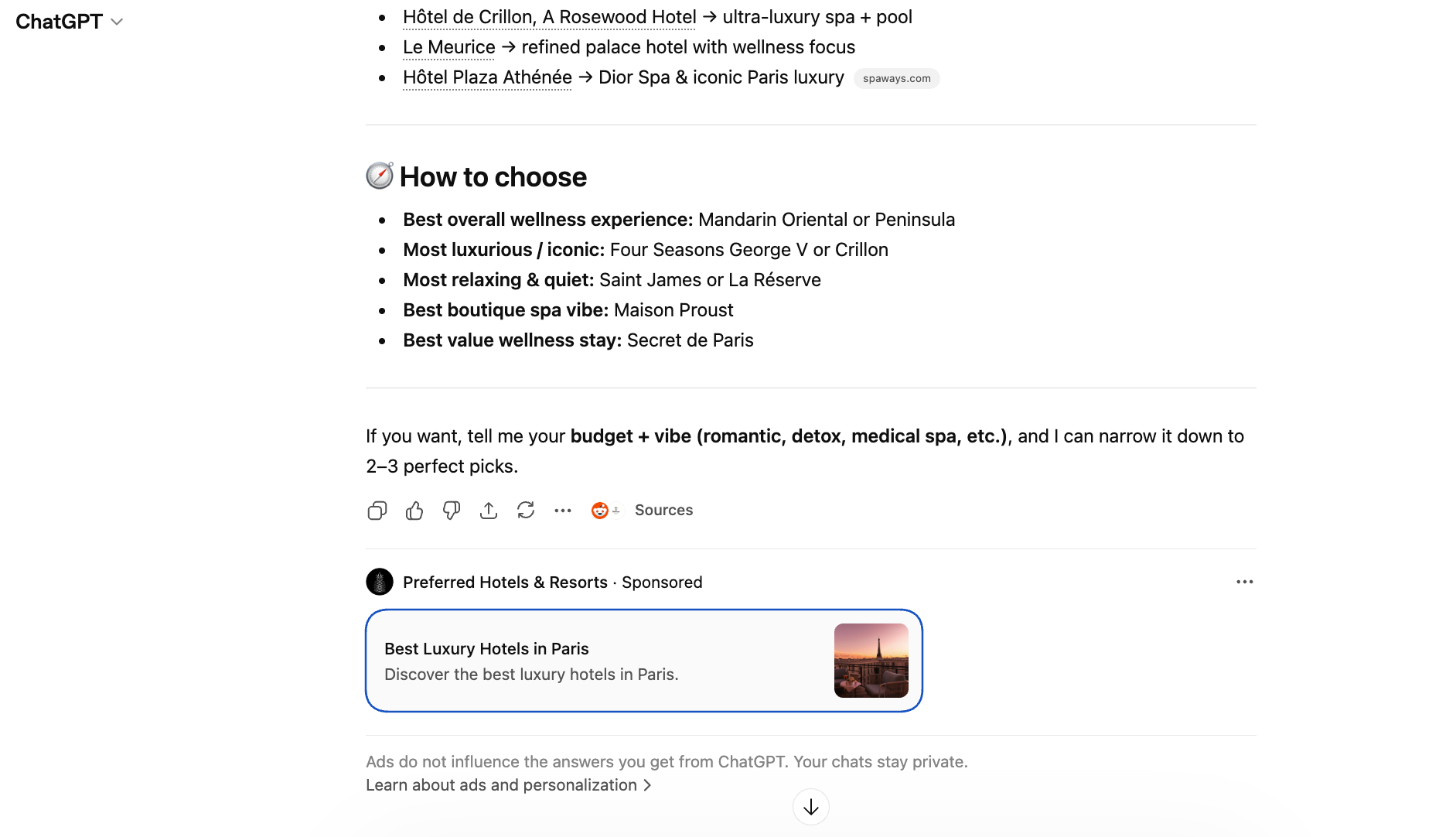
A Preferred Hotels & Resorts ad at the bottom of a Paris luxury hotel query. Note the “Sponsored” label and the disclaimer: “Ads do not influence the answers you get from ChatGPT.”
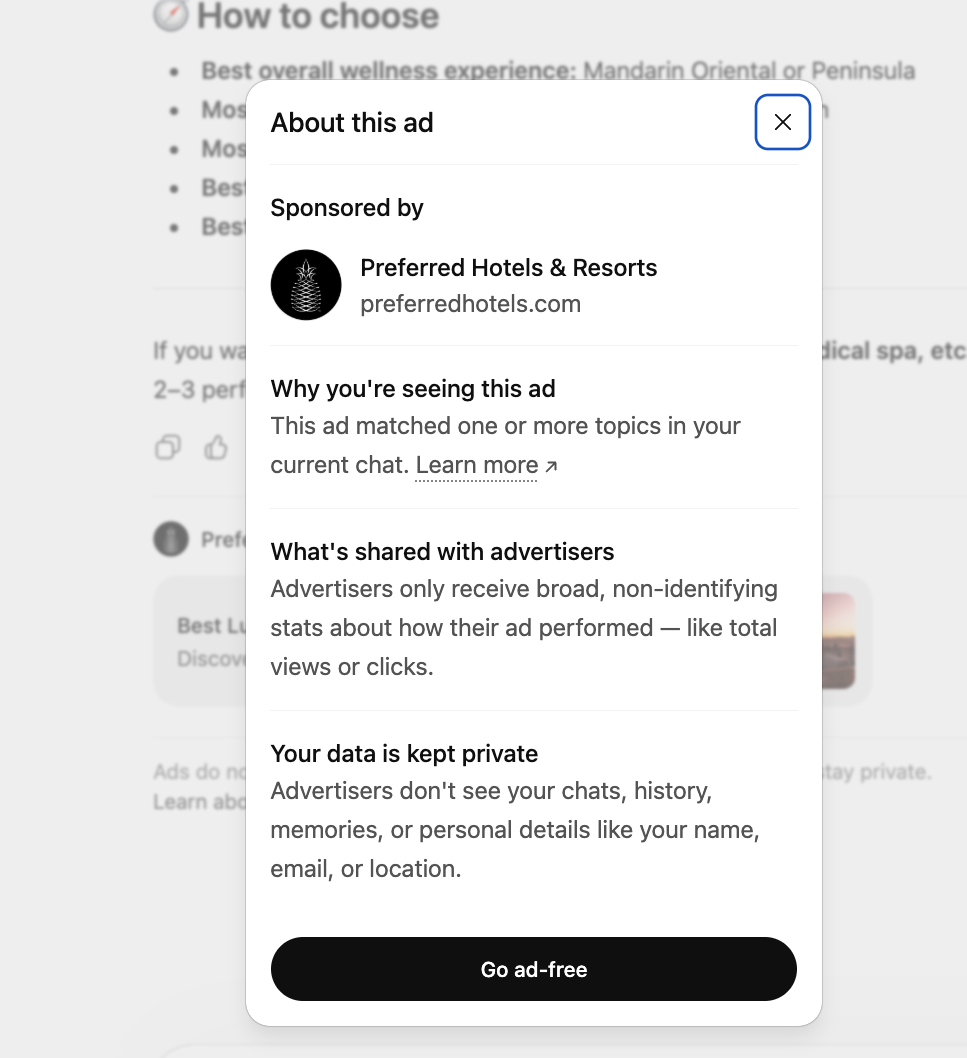
The “About this ad” modal. Key detail: “This ad matched one or more topics in your current chat.” Targeting is topic-based, not conversation-history-based. Advertisers only receive “broad, non-identifying stats.”
Placement
Ads appear at the bottom of the response, below the AI-generated hotel recommendations. They are clearly labeled as “Sponsored” with a small tag. The ad content is a clickable card with the advertiser's name, a short description, and sometimes an image. As OpenAI's own disclaimer states: “Ads do not influence the answers you get from ChatGPT. Your chats stay private.”
Targeting
Ads are matched to the topic of the query, not integrated into the recommendation. The “About this ad” modal confirms: “This ad matched one or more topics in your current chat.” A query about “boutique hotels in Rome” triggers travel/hotel advertisers, regardless of which specific hotels ChatGPT recommends. Targeting is based on user IP location (US only for now), not the destination.
Pricing
ChatGPT ads launched on a CPM (cost per thousand impressions) model with informal industry reports of $40–60 CPM. Around late April 2026, alongside the quiet launch of the ads manager, OpenAI pivoted to a CPC (cost-per-click) model — the more familiar performance-marketing model that aligns advertiser cost with downstream value rather than ad-slot exposure. CPC rates haven't been publicly confirmed yet; we'll update once observed in-market.
Eligibility & Enrollment
Advertisers can now sign up through OpenAI's newly-launched ads manager (advertiser page). The minimum spend commitment was reportedly $100,000+ at launch and has been dropped to about $50,000 as part of the same April update — still well above individual independent hotels but accessible to mid-size groups, consortiums, and direct-booking marketing budgets that a Booking.com or Expedia spends on a single market in a quarter.
The launch of a self-serve ads manager matters as much as the price: the early programme was a managed-sales model, gated by a sales conversation. Self-serve removes the gate.
$100M annualised revenue, six weeks in
Per Digiday, the ChatGPT ads programme reached an estimated $100 million annualised run-rate roughly six weeks into the test. Whether or not hotels remain a meaningful share of that revenue, the take-off velocity makes it clear OpenAI is treating ads as a strategic line of business, not an experiment. Expect the format and the advertiser pool to keep expanding.
The scraper impression problem (resolved by CPC) — and the new click-fraud one
Under the launch CPM model, every automated query that returned an ad counted as a paid impression — meaning AI-visibility monitoring tools (ours included) inflated advertiser bills without any human seeing the ad. The CPC pivot largely resolves this: bots don't click, so they don't cost.
The new failure mode is older and uglier. Scrapers can still extract the tracked ad target URL from a ChatGPT response — query string, click ID and all. A motivated bad actor could feed those URLs to a click farm (residential proxies, $0.001-per-click sweatshops, whatever) and burn a competitor’s ad budget for them. It’s the same attack Google, Meta, and the programmatic exchanges spent two decades building defences against — bot-traffic detection, click-quality scoring, refunded-impression credits. OpenAI starts that race from zero. Worth watching whether ChatGPT ad spend on the same hotel terms gets weirdly lumpy in the next few months. Hihi.
Inside a Real Ad Response
We captured the full raw response for “romantic hotels in Hollywood Hills” on March 31, 2026 — one of the first hotel queries to return an ad. Here's what the response stream reveals about how ChatGPT assembles a hotel recommendation with a sponsored placement.
The response stream in order
What the raw data reveals
The ad is separate from the answer
The ad arrives as a distinct type: "ads" event after the message stream completes. It's not injected into the model's output — it's appended by the serving infrastructure. The model never sees or generates the ad content.
Ad creative structure
Each ad contains a single_advertiser_ad_unit with the advertiser's brand info (name, favicon from bzrcdn.openai.com), a carousel of clickable cards (title + body + destination URL + image), and encrypted tracking tokens.
Notable: the ad's click target uses target.type: "url" — currently always an external URL (e.g. booking.com). But the schema accepts a type field, which means other target types are possible. A type: "app" target could let advertisers deep-link into a ChatGPT app/GPT — a Booking.com GPT, a Marriott concierge GPT, or The Hotels Network Connect AI app — instead of redirecting outside ChatGPT. This would keep users inside the platform — a potentially much higher-value ad format. No type: "app" ads have been observed yet, but the infrastructure appears ready for it.
OpenAI built an “Ask ChatGPT about this ad” feature
Buried in the Statsig configuration payload, we found a system prompt template for when users ask about ads shown to them. This confirms OpenAI anticipated users would interact with ads and built a dedicated response path:
Only 1 web citation for 6 hotels
Out of 6 recommended hotels, only The Hollywood Roosevelt gets an actual web citation — a 2016 Condé Nast Traveler article about Hollywood pools. The other 5 hotels are recommended based entirely on entity data (Yelp profiles, Google Place IDs) and the model's training knowledge. No TripAdvisor, no Booking.com, no editorial sources. For GPT-5.3, entity data providers — not web citations — drive the recommendation.
Hotel websites get direct links — then the ad redirects to Booking.com
Every hotel entity card includes a direct website_url link: theasterla.com, carahotel.com, magiccastlehotel.com, hollywoodhillshotel.com, marriott.com for The Hollywood Grande. All with ?utm_source=chatgpt.com tracking. The organic answer links to hotel direct sites. Then the ad at the bottom links to Booking.com. The direct-booking paradox in action.
What This Means for Hotels
1The OTA tax follows you everywhere
Hotels hoped AI search would be a direct-booking channel — and to some extent it is (ChatGPT surfaces hotel websites in its organic recommendations). But with OTAs owning 87.7% of ad inventory, the last thing a user sees after a hotel recommendation is a Booking.com ad. The channel may generate awareness directly, but the conversion path loops back through OTAs.
2Free users are the ad audience — and that's 95% of ChatGPT
Ads only appear on free/Go tiers. Roughly 95% of ChatGPT's user base is on these tiers. This means the vast majority of hotel recommendations served by ChatGPT now come with OTA advertising attached. Paid users (Plus/Pro) don't see ads, but they're a small minority.
3Independent hotels still locked out, but the door is opening
At launch the $100K+ commitment plus managed-sales gate kept the channel exclusive to large OTAs and chains. The April 29 update — self-serve ads manager + entry dropped to ~$50K + a CPC model that doesn't pre-pay for impressions — halves the barrier and lowers the activation energy. Single independent properties still can't justify the spend, but the consortium path Preferred Hotels & Resorts pioneered (8.2% share) gets meaningfully easier. Watch for marketing collectives, soft brands, and DMC bookings to start appearing.
4US-only at launch (April 2026), but this will expand
Limited to US IPs at the April 2026 measurement, but the ad infrastructure is built. European and Asian expansion is a matter of when, not if. Hotels in Paris, Rome, and Tokyo should prepare for a world where ChatGPT recommendations come with OTA ads attached — even if the organic answer links to their direct site.
5The new distribution math
In traditional search, you pay Google to appear in results. In AI search, you appear for free in the organic answer — but OTAs pay to intercept the user at the last step. The hotel wins the recommendation but may lose the booking. This is a fundamentally new distribution dynamic, and hotels need to understand it before it scales beyond the US.
How We Collected This Data
Monitoring Setup
- Platform: ChatGPT.com (web interface)
- IP: US-based residential IP
- Tier: Free / Go account (no Plus/Pro)
- Method: Automated headless browser captures
- Period: December 25, 2025 – April 13, 2026
What We Captured
- Presence of “Sponsored” label in response
- Advertiser name and branding
- Full response text (organic + sponsored)
- Prompt text and query metadata
Data Summary
- 613 successful queries in the ad-active period (Mar 31 – Apr 13)
- 170 queries with sponsored ads (27.7%)
- 9 unique advertisers observed
- 6,000+ queries pre-ads (Jan–Mar 23) as baseline
Limitations
- US IP only — we cannot measure ad rates in other regions
- Free/Go tier only — Plus/Pro ad behavior is untested
- Automated captures — ad experience may differ for logged-in users with history
- Advertiser share is based on observed impressions, not actual spend or bid data
Data Access
We believe in open research. Contact us for access to the raw monitoring data and methodology details.
Frequently Asked Questions
Continue Reading
This study is part of our ongoing research into how AI search engines monetize hotel recommendations.